Why Aged Basmati Rice Costs More — And What You're Actually Paying For
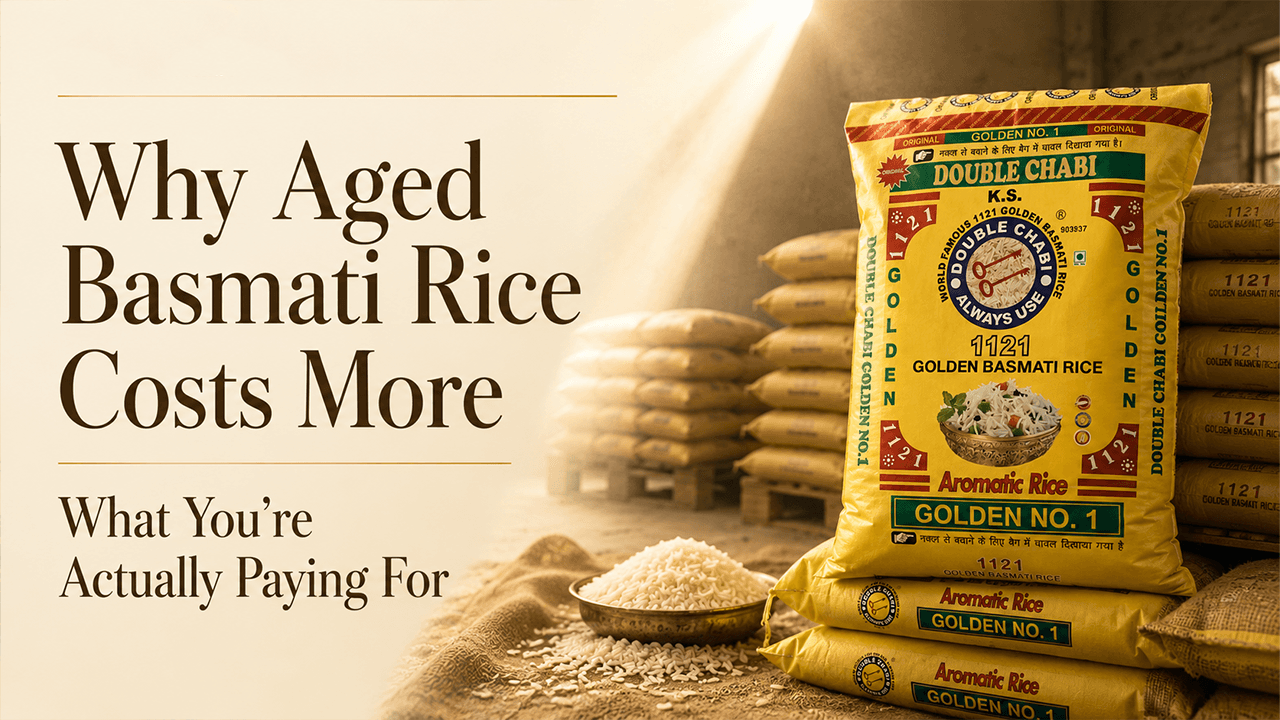
The price difference between an aged premium Basmati and a commodity Basmati is not a margin decision. It is an inventory decision made 18 months before the bag reaches the shelf. Understanding what is in that price gap helps you make a better purchase decision — and stops you from comparing things that are not comparable.
The Working Capital Reality of 18-Month Aging
When Double Chabi procures paddy at harvest in October and November, the paddy sits in our warehouse for 12 to 18 months before it is milled and packaged. During that entire period, the working capital invested in that paddy is unavailable for any other purpose.
A mill that ages 500 metric tonnes of paddy for 18 months is carrying the procurement cost, warehouse cost, and insurance on 500 metric tonnes of rice for a year and a half before it generates a single rupee of revenue from that inventory. In an industry where margins are not large, this is a significant capital commitment.
A mill that mills and sells paddy within six months of procurement — which is common — has turned that same inventory three times in the period the aging mill is still waiting. Three inventory cycles versus one. The economics are not subtle.
This is why genuine aging is expensive. Not because it requires sophisticated technology or rare ingredients, but because it requires patience and capital that most operations choose to deploy elsewhere.
How Moisture Loss During Aging Affects Yield — and Price
Paddy at harvest typically contains 13 to 14 percent moisture. After 12 to 18 months of aging in a properly ventilated warehouse, moisture content drops to below 12 percent. That seems like a small difference. In terms of yield, it is significant.
A metric tonne of paddy at 14 percent moisture contains approximately 140kg of water. After aging to 11.5 percent moisture, the same batch now contains approximately 115kg of water. The difference — approximately 25kg per tonne — is weight that was purchased at the paddy's original cost per kg and has since evaporated.
When you are aging thousands of tonnes of paddy annually, that moisture loss is a real cost. It is not usually shown on a line item anywhere visible to the buyer, but it is built into the price of every bag of genuinely aged Basmati.
Warehouse Infrastructure and Quality Monitoring Costs
Aging paddy is not simply leaving it in a room. Done correctly, it requires:
- Ventilated warehouse space with sufficient air circulation to allow moisture to escape without creating condensation zones
- Jute bag storage rather than polypropylene, because jute breathes and polypropylene does not
- Periodic turning and inspection of stored batches to prevent hot spots or moisture concentrations
- Temperature and humidity monitoring, particularly through the monsoon season when ambient humidity can affect the aging environment
- Fumigation protocols to protect long-duration stored grain from pest infestation
None of these are large costs individually. Together, for a mill aging significant volumes over 12 to 18 months, they represent a meaningful operational expense that shorter-aging operations do not incur.
What You Actually Get — The Measurable Difference in the Grain
The costs above would be justifiable only if they produced a measurably better product. They do.
Aroma: The primary aromatic compound in Basmati — 2-acetyl-1-pyrroline — concentrates as moisture leaves the grain during aging. A properly aged 1121 Basmati has a fragrance detectable in raw grain that fresh-milled Basmati does not. In the cooked dish, the aroma difference is significant enough to be noticed by any experienced cook.
Elongation: The internal starch structure of the grain firms up during aging. This produces more consistent elongation during cooking — grains that stretch to their full potential and separate cleanly rather than sticking. Cooked elongation of properly aged Double Chabi 1121 exceeds 20mm. Fresh-milled 1121 from the same variety typically cooks to 15 to 17mm.
Texture: Aged grain has a firmer cooked texture that holds longer at temperature without becoming mushy. For home cooking, this means the rice stays good for longer after cooking. For commercial kitchens, it is the difference between rice that lasts through a service period and rice that does not.
The Brands That Skip Aging — and What That Means for the Cook
It is worth being precise here: a brand that sells six-month-aged or unaged Basmati is not selling a dishonest product. They are selling a different product at a different price point. The issue arises when unaged or under-aged rice is marketed with language that implies the full aging benefit without delivering it.
If you have bought "premium aged Basmati" and found that it does not smell significantly different from standard rice before cooking, or that the grains stick together more than expected, or that the elongation is disappointing, you have likely purchased rice that was marketed as premium but was not processed to the standard the marketing implied.
The solution is not to pay more blindly. It is to buy from millers who specify their aging period, provide documentation on request, and can be held accountable to the claim on their packaging.
Why Double Chabi Prices What It Does
Every bag of Double Chabi 1121 Basmati represents paddy that was procured directly from farming families in the Taraori belt, stored in Karnal for 12 to 18 months, milled to a specification that produces less than 2 percent broken grain, and sortex-graded before packaging.
The price reflects those decisions. It does not reflect celebrity endorsements, heavy television advertising, or supermarket listing fees. Those costs are real in the branded Basmati market, but they do not improve the grain.
What Double Chabi charges for is the grain itself — and the operational decisions made 12 to 18 months before it reaches you. That is what you are paying for when you buy properly aged Basmati from a direct miller. And that is what you are not getting when the price is the same as commodity rice.
Aged Basmati costs more because the miller waited 18 months and lost margin to moisture before the grain earned a single rupee. The price is the proof of the patience.
Frequently Asked Questions
- Why is aged Basmati rice more expensive than regular Basmati?
- Aged Basmati requires 12 to 18 months of warehouse storage before milling, during which the miller carries the full working capital cost of the inventory with no revenue. Moisture loss during aging also reduces yield by approximately 25kg per tonne. Both costs are built into the price of genuinely aged Basmati.
- Is premium aged Basmati rice worth the higher price?
- For cooking purposes where aroma, elongation, and grain separation matter — biryani, pulao, festive cooking — properly aged Basmati produces measurably better results. The cooked elongation of 18-month aged 1121 Basmati (20mm+) versus fresh-milled 1121 (15–17mm) is a real and noticeable difference in the finished dish.
- How can I tell if I am paying for genuine aging?
- Ask the supplier for their aging period specification and warehouse receipt documentation. Test the raw grain aroma — properly aged Basmati smells distinctly floral before cooking. Cook the rice and measure elongation. A brand that cannot specify its aging period and provide supporting documentation is making an unverifiable claim.
- What is the difference between cheap and expensive Basmati rice?
- The main differences are: (1) aging period — premium rice is aged 12–18 months, commodity rice 3–6 months or less; (2) grain variety — premium uses 1121 or traditional Basmati, commodity often uses non-Basmati or short-grain varieties; (3) broken grain percentage — premium is below 2%, commodity can be 5% or higher; (4) origin — premium is GI-certified from specific districts, commodity may be blended from multiple sources.