From Karnal to 15 Countries — The Story of Double Chabi's 70-Year Basmati Journey
Some businesses are built quickly and scaled faster. Double Chabi is not that kind of business. It was built one harvest at a time, by three generations of a family who understood that the grain sets the standard — and the standard does not negotiate.
Founded in the Early 1950s — Late Shri Kashmiri Lal and the First Mill
Double Chabi was established in the early 1950s by Late Shri Kashmiri Lal in Kurak, Taraori, within the Karnal district of Haryana. The timing was not incidental. Karnal had established itself as one of the most productive Basmati-growing regions in India, and the Taraori belt specifically — with its loamy soil, canal irrigation, and favourable temperature conditions during the growing season — was producing grain of a quality that commanded recognition beyond local markets.
Kashmiri Lal began with a straightforward proposition: mill and sell the best rice from the region's best harvests, hold it properly before milling, and build relationships with farmers and buyers who valued quality over volume. The Double Chabi brand — featuring the image of two keys, symbolising the unlocking of quality and trust — was created to represent these founding values.
The early operation supplied domestic wholesale markets across North India. The reputation for consistent quality in a category where inconsistency was common began to build market by market, buyer by buyer.
Second Generation — Brij Bhushan Goyal and Jitender Goyal Scale the Operation
The second generation — Brij Bhushan Goyal and his brother Jitender Goyal, sons of the founding family — inherited an operation with an established reputation and a clear philosophy. Their task was to scale it without compromising either.
Under their stewardship, Double Chabi modernised its milling facility to include sortex colour-sorting technology, expanded its warehouse capacity to support longer aging cycles, and developed its export operation. The APEDA registration that enabled legal export of processed rice to international markets was secured, and the first shipments to Gulf Cooperation Council countries established what would become a significant part of the business.
Brij Bhushan Goyal's approach to the business has been characterised by the same discipline that defined the founding generation: direct procurement from farming families the operation has worked with for decades, strict intake quality checks, and an unwillingness to ship product that does not meet the milling specification. In over 40 years of running the operation, the standard has not been negotiated downward in a difficult harvest year.
Jitender Goyal oversees the production floor and processing operations. His knowledge of the milling process is the kind that comes from decades of hands-on work — understanding what a batch of paddy looks and smells like at intake, how temperature and humidity affect the aging process, and what the sortex data tells you about a harvest's quality profile.
Third Generation — Pushkar and Akshat Bring DC into Digital Commerce
Pushkar Goyal and Akshat Goyal, sons of Brij Bhushan Goyal, joined the business directly after completing their education. Both came in with a clear understanding of what they were inheriting and what it required of them.
Pushkar leads international growth and digital commerce. Under his direction, Double Chabi has established a D2C e-commerce presence at doublechabirice.com, listed on quick commerce platforms including Blinkit and Zepto, and begun building the brand's digital marketing infrastructure — YouTube cookery content, social media presence, and the brand's expanding reach among urban consumers who buy premium rice online rather than from wholesale markets.
Akshat oversees supply chain and operations. His focus is on the upstream end of the business: paddy procurement, farmer relationships, quality systems at intake, and the logistics of moving a perishable agricultural commodity from farm to warehouse to mill to packaging with consistency across every batch.
Together, the third generation is extending a 70-year business into new channels without changing what made it worth extending. The grain is still sourced from the same farming families. It is still aged in the same Karnal warehouses. It still has to pass the same intake specifications before it is accepted for processing.
The Grain That Never Changed — 70 Years of the Same Commitment
The most notable aspect of Double Chabi's history is not the expansion. It is the consistency. The same operational principles that Kashmiri Lal applied in the 1950s — direct farmer procurement, proper aging, quality-first milling — remain the operating standard in 2026.
This is not sentimentality. It is a recognition that the quality of aged premium Basmati is an agricultural and chemical reality. The aging process that concentrates the aromatic compounds in 1121 Basmati takes the time it takes. The soil conditions in Karnal that produce the grain's specific elongation and fragrance profile cannot be replicated elsewhere. The farmer relationships that give Double Chabi access to the best lots from each harvest have been built over decades and cannot be purchased.
In an industry where many brands are marketing operations that source from commodity channels and package to specification, Double Chabi is a miller first. The brand is the product of the grain's quality, not the other way around.
From North India to 15 Countries — The Export Journey
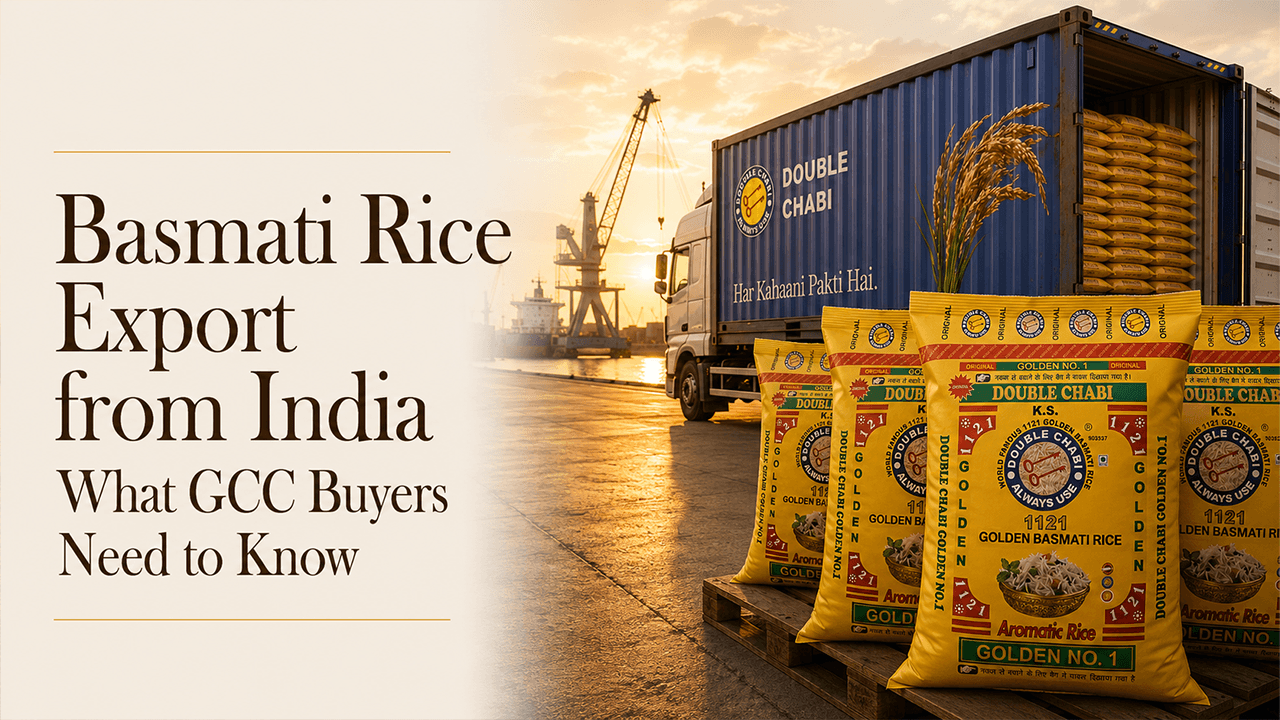
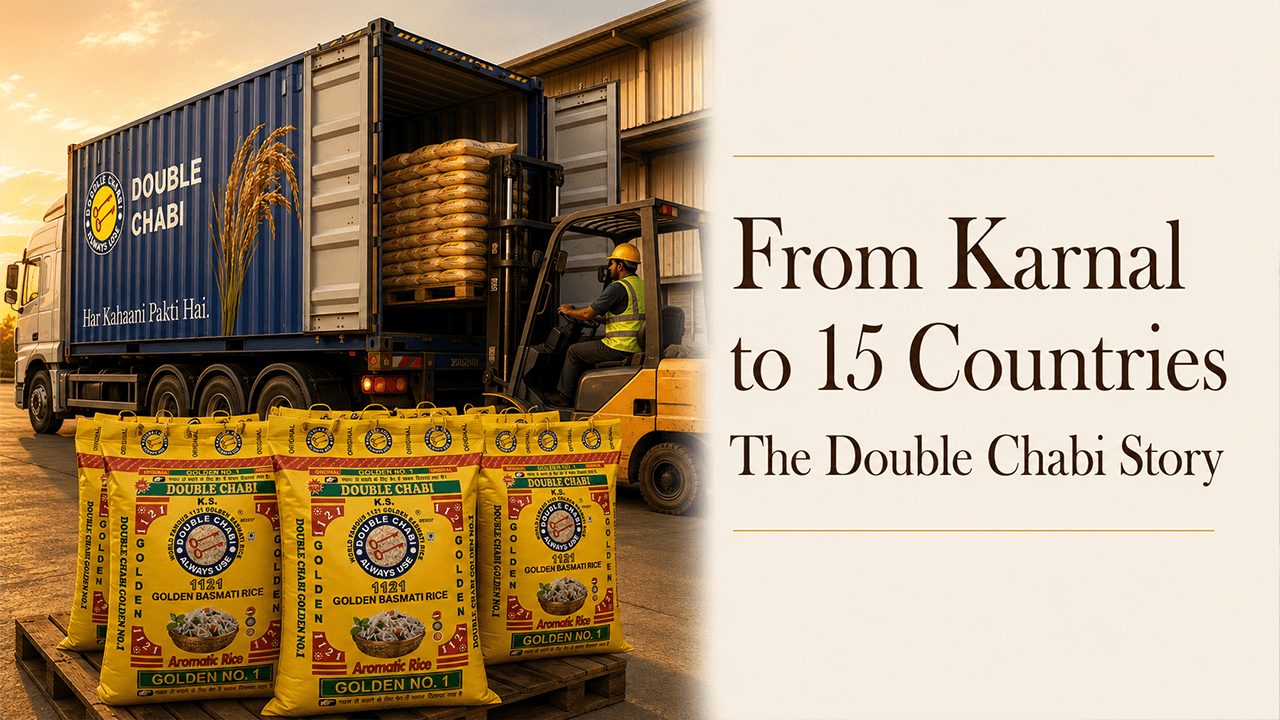
Double Chabi currently exports to over 15 countries across the GCC, Southeast Asia, and Europe. The export operation is APEDA certified and maintains all documentation required for international trade, including per-batch phytosanitary certificates and pesticide residue test reports.
The international markets that receive Double Chabi Basmati are among the most demanding in the world for rice quality. GCC buyers in particular have elevated their quality specifications significantly over the past decade, requiring detailed documentation of growing origin, milling process, and aging period. The fact that Double Chabi has maintained and grown its international customer base is a third-party validation of the operational standards the company has maintained for 70 years.
Why the Double Chabi Name and Symbol Matter
The name "Double Chabi" — meaning "double key" — and the two-key symbol were chosen by the founding generation to represent the brand's commitment to quality and trust. The two keys unlock, respectively, the quality of the grain and the trust between the miller and the buyer. Both are required. A grain of exceptional quality that is sold without consistency or transparency is not a premium product. A trustworthy relationship built on inconsistent product is not a lasting one.
Seventy years later, the same symbol appears on every pack. Not because of brand conservatism, but because the meaning of those two keys has not changed. What Double Chabi sells, in 2026 as in the 1950s, is the combination of a grain that earns its description and a business that stands behind it.
Frequently Asked Questions
- What is Double Chabi rice?
- Double Chabi is a premium Basmati rice brand from Karnal, Haryana, India. Founded in the early 1950s, it is now run by the third generation of the Goyal family. Double Chabi mills and sells naturally aged 1121 Basmati, Golden No.1 Sella Basmati, and Royal Basmati from its facility in Kurak, Taraori, Karnal.
- Who owns Double Chabi rice?
- Double Chabi is a family-owned business. The second generation — Brij Bhushan Goyal and Jitender Goyal — currently lead the operation. The third generation — Pushkar Goyal (international growth and digital commerce) and Akshat Goyal (supply chain and operations) — is actively involved in growing the business.
- Where is Double Chabi rice manufactured?
- Double Chabi rice is milled at the company's facility in Kurak, Taraori, Karnal, Haryana — within the GI-certified Basmati-producing region. The company's registered entity is KS Agro Impex, Karnal.
- Does Double Chabi export rice internationally?
- Yes. Double Chabi exports premium Basmati rice to over 15 countries across the GCC, Southeast Asia, and Europe. The operation is APEDA certified and maintains full international trade documentation for all export consignments.