Basmati Rice Export from India — What GCC Buyers Need to Know in 2026
India exports more Basmati rice than any other country in the world. The GCC is its largest destination market. But the standards that GCC buyers apply have changed significantly over the past five years — and the mills that have adapted to those changes are not the same ones that were dominant a decade ago.
India's Basmati Export Landscape in 2026
India exported approximately 5.4 million metric tonnes of Basmati rice in 2024–25, with the Gulf Cooperation Council countries — Saudi Arabia, UAE, Kuwait, Qatar, Bahrain, and Oman — accounting for roughly 45 to 50 percent of total volume. The UK, USA, Canada, and Australia collectively account for another 20 percent.
Haryana is the leading state for premium 1121 and Pusa Basmati exports, contributing significantly to the GI-certified export volume. The Karnal district specifically is the origin point for a substantial proportion of the long-grain premium grades that GCC and European buyers specify.
The Indian government's APEDA (Agricultural and Processed Food Products Export Development Authority) governs the registration and certification of Basmati exporters. Only APEDA-registered entities can legally export Basmati rice with the GI designation. This registration is a baseline requirement, not a quality certification in itself — it confirms legal compliance, not product quality.
Why GCC Buyers Are Shifting to Quality-First Sourcing
Until approximately 2018 to 2020, the dominant GCC procurement model for Basmati rice was volume-first and price-sensitive. Large-volume trading companies would source from multiple mills, blend grades, and compete primarily on price and availability. The consumer on the other end was buying a category rather than a brand.
This has changed substantially. Several factors have driven the shift:
Retail consolidation: Large GCC retail chains — Lulu, Carrefour, Union Cooperative — have moved toward branded and origin-certified premium Basmati in their premium aisles, with private-label and commodity grades occupying the value tier. This bifurcation has created two distinct procurement tracks where previously there was one.
Consumer education: The Indian diaspora in GCC countries — a population of over 3 million — has driven demand for brands that they recognise from India. Heritage and origin have become purchase drivers, not just price.
Regulatory tightening: Maximum Residue Limits (MRL) for pesticide residue in food imports have been progressively tightened across GCC markets. Buyers who previously conducted minimal testing now require per-batch certification.
Post-COVID supply chain awareness: The supply chain disruptions of 2020 to 2022 pushed many large GCC buyers to consolidate their supplier base around fewer, more reliable, better-documented sources rather than maintaining a large number of interchangeable options.
Documentation Requirements for Indian Basmati Export to GCC
Any Indian Basmati rice exporter supplying GCC markets is required to provide the following per-consignment documentation:
- APEDA Export Certificate: Confirms the exporter is registered and the consignment is being exported under the legally designated Basmati GI.
- Phytosanitary Certificate: Issued by the Plant Quarantine Authority, certifying the consignment is free from regulated pests and plant diseases. Required at port of entry in all GCC countries.
- Certificate of Origin: Confirms India as the country of origin. Required for tariff preference documentation under India-GCC trade agreements.
- Pesticide Residue Analysis Report: Per-batch laboratory analysis from an accredited testing facility confirming pesticide residue levels are within the importing country's MRL limits. Saudi Arabia, UAE, and Kuwait all specify their own MRL schedules — ensure your supplier tests to the specific market's requirements, not a generic report.
- Moisture and Quality Certificate: Specifies moisture content at milling, percentage of broken grain, and grain length specification. Important for confirming the product matches the contracted specification.
What to Look for in an Indian Basmati Exporter — 6 Criteria
The difference between a premium mill and a commodity trading house is significant — and not always obvious from a company presentation or website. Here are six criteria that distinguish genuine premium Basmati suppliers:
1. Origin Transparency
Can the supplier specify the district of paddy origin? The village or procurement network? Premium mills have this information because they buy directly from farmers they know. Trading companies that buy on the open market often cannot trace paddy to its origin. For GI-certified Basmati, origin documentation is both a legal requirement and a quality indicator.
2. Aging Period Documentation
Will the supplier specify the aging period for the batch being purchased — not just a marketing claim on the website, but a warehouse receipt date that shows when the paddy entered storage and when it was milled? Genuine 12 to 18 month aging leaves a paper trail. Abbreviated aging does not.
3. Broken Grain Specification
Ask for the broken grain percentage for the batch being purchased. Premium grade 1121 Basmati should be below 2% broken grain. Medium grade runs 2 to 5%. If a supplier cannot provide a per-batch broken grain percentage, they are operating to blended rather than specified quality.
4. Per-Batch Pesticide Residue Testing
Request testing reports specific to your destination market's MRL schedule, not a generic all-markets report. Suppliers who conduct rigorous testing maintain this documentation readily. Suppliers who test minimally will experience delay in providing it.
5. Physical Facility Visit or Third-Party Audit
For significant volumes, a facility visit or third-party quality audit is standard practice. Any premium supplier should welcome this. A supplier who discourages a facility visit is communicating something important about their operation.
6. References from Existing GCC Buyers
Request references from existing GCC customers. Long-standing relationships with named GCC retail or wholesale buyers are the strongest indicator of consistent quality delivery over time.
How Double Chabi Supplies GCC and International Markets
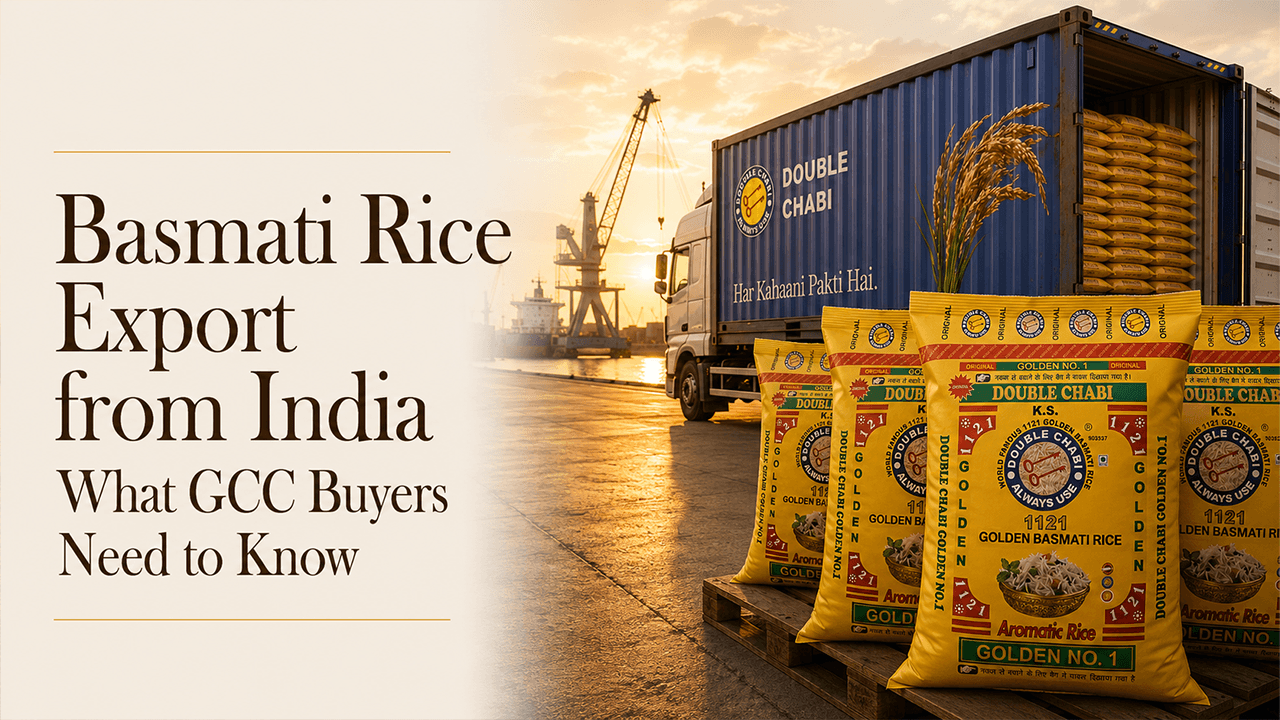
Double Chabi has been supplying GCC and international markets for several decades. The operation is APEDA certified, and all export consignments are accompanied by the full documentation package described above — including per-batch pesticide residue analysis to the destination market's specific MRL schedule.
All rice exported under the Double Chabi brand is sourced from the Taraori-Karnal belt, aged at the company's Karnal facility, and milled to the company's quality specification before export packaging. The three primary export grades are 1121 Extra Long Basmati, 1121 Golden Sella Basmati, and Royal Basmati.
How to Place a Bulk Export Inquiry
For wholesale pricing, minimum order quantities, and full export documentation, contact Double Chabi through doublechabirice.com/contact. Please specify your destination country, product grade, required volume, and preferred packaging specification. The team will respond within two business days with a full quotation and documentation package.
Frequently Asked Questions
- How do I import Basmati rice from India?
- To import Basmati rice from India, you need to work with an APEDA-registered Indian exporter who can provide a phytosanitary certificate, certificate of origin, pesticide residue test report, and APEDA export certificate. These documents are required at port of entry in all major importing countries including GCC nations, UK, and USA.
- What is the minimum order quantity for Basmati rice export from India?
- MOQs vary by supplier and grade. Most premium mills operate with minimum orders of one FCL (Full Container Load), which typically contains 18 to 22 metric tonnes of packaged rice. Some suppliers accept smaller LCL shipments for new buyers or trial orders. Contact doublechabirice.com for specific MOQ information.
- Which Indian state produces the best Basmati rice for export?
- Haryana — particularly the Karnal-Taraori belt — produces the highest-regarded premium Basmati for export. The soil conditions, water source, and temperature profile of this region produce GI-certified Basmati with the elongation, aroma, and texture characteristics that international premium markets specify.
- Does Double Chabi Rice export to the GCC?
- Yes. Double Chabi is an APEDA-certified exporter supplying GCC and international markets. Contact doublechabirice.com/contact for export pricing, documentation, and MOQ details.