
How to Tell If Your Basmati Rice Is Actually Aged — 5 Tests You Can Do at Home
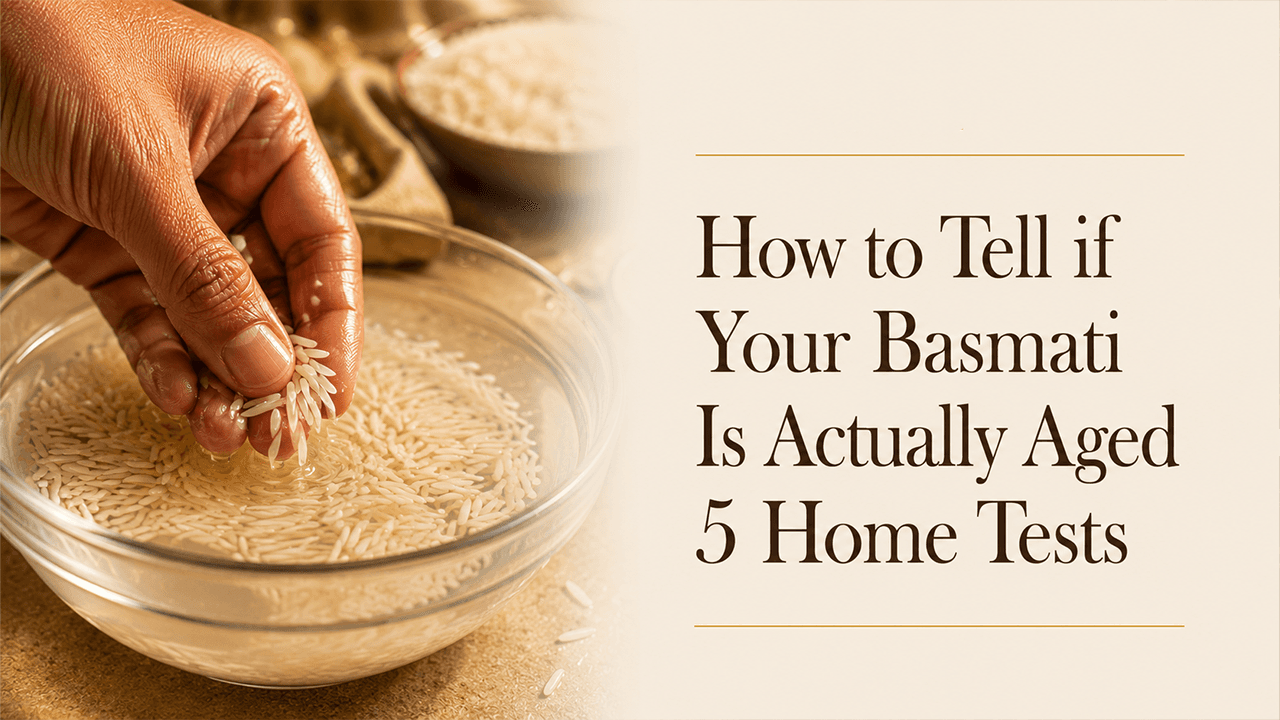
The word "aged" appears on most premium Basmati packaging. What it means in practice — and how to verify it before you buy — is something most brands would rather you not think too hard about. Here is how to check it yourself, in five steps, before the rice reaches your kitchen.
Why Aging Matters: What Happens to Basmati Over 12–18 Months
When paddy is harvested and milled, the grain contains between 13 and 14 percent moisture. At this stage, the grain is relatively soft internally and cooks unevenly. The aromatic compounds — the ones responsible for Basmati's signature floral fragrance — are present but not yet concentrated.
Over 12 to 18 months of proper storage in ventilated, temperature-managed warehouses, three things happen. First, moisture content drops to below 12 percent, firming up the internal starch structure. Second, the aromatic compounds intensify — the grain develops a deeper, more complex fragrance that holds through cooking. Third, the cooked elongation increases: the grain stretches further and stays separated for longer.
None of these changes are visible on the packaging. The only way to verify them is to test the grain itself.
Test 1 — The Aroma Test (Raw Grain in Palm)
Take a small handful of raw rice grains. Rub them firmly between both palms for five to ten seconds. Then hold your palms close to your nose and inhale.
Properly aged Basmati: A clear, distinctive fragrance — slightly floral, slightly nutty, with what experienced cooks describe as a "pandan-like" or "popcorn" note. The fragrance is immediate and unmistakeable.
Fresh or under-aged Basmati: Very little fragrance, or a faint "raw grain" smell that does not resemble the aroma Basmati is known for.
This test alone tells you more than any label. Aged grain smells like Basmati before it is cooked. Fresh grain does not.
Test 2 — The Weight Test (Moisture Content Indicator)
Aged grain is lighter than fresh grain for the same volume. This is because the aging process reduces moisture content — and water is heavy.
Compare two brands side by side if possible. Fill a small cup with each and hold one in each hand. Properly aged rice will feel noticeably lighter for the same volume. The difference is subtle but detectable once you know what to look for.
If only one brand is available, pour the rice between your palms. Aged grain flows freely and feels almost dry. Fresh grain has a slight resistance to flow and feels marginally denser.
Test 3 — The Cook Test (Elongation Measurement)
This is the most definitive test, though it requires cooking the rice first. Measure one grain of raw rice with a ruler or against a fixed reference. Cook the rice normally and measure the same grain after cooking.
Properly aged 1121 Basmati: The grain elongates to more than double its raw length. A raw grain of 8.3mm should cook out to 20mm or longer.
Fresh or under-aged Basmati: Elongation is significantly less — typically 12 to 15mm from a similar raw length — and the grains are more likely to stick together.
Any premium Basmati brand that markets on quality should be able to provide their elongation specification. If they cannot, that tells you something important.
Test 4 — The Colour Test (Aged vs Fresh Grain Visual Difference)
Freshly milled Basmati is bright white. Properly aged Basmati develops a very subtle ivory or cream tone — not yellowing, which indicates poor storage, but a gentle warmth in the colour that is different from the stark whiteness of fresh grain.
This is easiest to see in natural light against a white background. Place a small amount of rice on a white plate and examine it in daylight. Bright white throughout suggests recent milling. A very slight cream tone across the majority of grains is the visual indicator of proper aging.
Important note: deep yellowing, uneven colour, or dark spots indicate damage or improper storage. These are negative indicators, not positive ones. The change in aged grain is subtle — warmth, not discolouration.
Test 5 — The Label Test (What to Look for on the Pack)
Most brands that have genuinely aged their rice will say so explicitly on the packaging — and will specify the aging period. Look for phrases like "aged 12 months," "18-month aged," or "naturally aged."
Generic phrases like "premium quality," "extra long grain," or "aged Basmati" without a specific timeframe are not verifiable claims. Any miller who has actually invested in 12 to 18 months of warehouse holding has a strong commercial incentive to specify exactly how long — because that investment is a real differentiator.
Also check the milling date and best-before date. A genuine 12-month aged product should show a milling date that is at least 12 months after the harvest year. If the pack shows a harvest and milling date within six months of each other, the aging claim requires closer scrutiny.
Double Chabi ages its 1121 Basmati for a minimum of 12 months in Karnal before milling. The aroma test, the weight test, and the elongation test can all be run on any pack. We are confident in what you will find.
What Double Chabi's Aging Process Looks Like
After harvest in October and November, paddy is brought to Double Chabi's facility in Kurak, Taraori, Karnal. It is stored in large ventilated jute bags in dry warehouses where temperature and humidity are monitored through the storage period.
Over the following 12 to 18 months, moisture is released naturally through the jute and ventilation. The grain is turned and checked periodically. Only when the moisture levels and aroma profile meet the milling specification is the paddy transferred to the processing line for de-husking, whitening, sortex grading, and packaging.
This is not a fast process. It requires carrying 12 to 18 months of paddy inventory as working capital before a single bag reaches the consumer. That is the actual cost of genuine aging — and why not everyone who claims to sell aged Basmati is selling the same thing.
Frequently Asked Questions
- How do I know if Basmati rice is aged?
- Rub raw grains between your palms and smell them — properly aged Basmati has a clear floral and nutty fragrance even before cooking. You can also check the pack for a specific aging period (e.g. "aged 12 months") and compare the milling date to the harvest year.
- What is the difference between fresh and aged Basmati rice?
- Aged Basmati has lower moisture content (below 12% vs 13–14% for fresh grain), stronger fragrance, better elongation on cooking (grains stay separate and stretch further), and firmer texture. Fresh Basmati cooks softer, sticks more easily, and has less pronounced aroma.
- Why does aged Basmati rice taste better?
- During aging, the aromatic compounds in Basmati — particularly 2-acetyl-1-pyrroline, the compound responsible for its distinctive fragrance — concentrate as moisture leaves the grain. The starch structure also changes, producing a firmer, more separate cooked grain. Both changes improve the cooking and eating experience.
- How long should Basmati rice be aged before it is good?
- A minimum of 12 months of proper storage is generally accepted as the threshold for premium aged Basmati. Many millers age for 18 months for more pronounced results. Anything marketed as "aged" with less than 12 months of verifiable storage time should be treated with caution.